
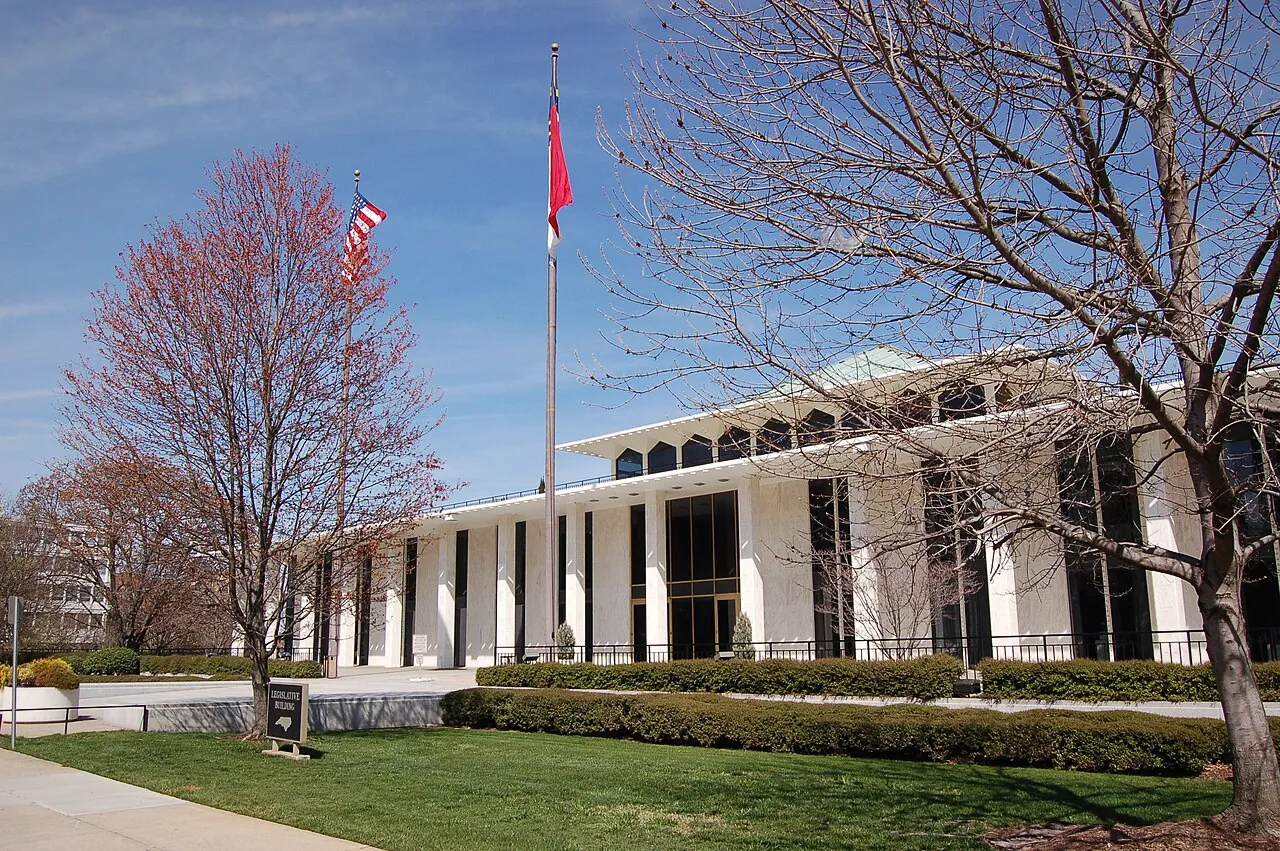
North Carolina sends 14 people to the U.S. House. For ten years, the fight over who draws their districts has run through the General Assembly, the state Supreme Court and the U.S. Supreme Court, and back again. Millions of voters were sorted and resorted. Since 2016, state and federal courts have ordered lawmakers to draw five more maps, WUNC reported last year.
This fall, the whole decade came down to a few hundred ballots in eastern North Carolina.
Every result in this story is unofficial until the State Board of Elections certifies on Nov. 24.
I. Two hundred ninety-three
On election night, Nov. 3, Rep. Greg Murphy led his Democratic challenger, Raymond Smith, by 233 votes in the 3rd District, the Carolina Journal reported. Murphy, a Republican physician from Greenville, had held the seat since 2019. The district had been drawn to keep him there. Under its new lines, Donald Trump would have carried it by about 13.6 points, WUNC reported.
Then the counties counted the rest. Provisional ballots, which are cast when a voter's eligibility has to be checked first, came in over the next week, along with mail ballots whose paperwork problems had been fixed. On Nov. 10, Smith pulled ahead. When the counting stopped, he had 118,488 votes and Murphy had 118,195, a margin of 293, according to unofficial state results reported by the Carolina Journal.
The next day, Murphy congratulated him. "I am sure he will serve the next two years with honor and integrity," Murphy wrote. He added that he would "be remiss if I did not express personal disappointment."
Smith went to Washington for freshman orientation. Asked how the race had turned, he pointed at the map. "The legislature moved some Republican-leaning counties into the first," he told WCTI.
He was right about the move. To understand why it did not save the seat, you have to go back to a committee room in Raleigh in 2016, and to a number.
II. The number was 11
In February 2016, a federal court ordered North Carolina to redraw its congressional map. Rep. David Lewis, a Republican who co-chaired the redistricting committee, told his colleagues what the new map was for.
He proposed drawing "the maps to give a partisan advantage to 10 Republicans and 3 Democrats." Why not more? He did "not believe it [would be] possible to draw a map with 11 Republicans and 2 Democrats." Both lines are quoted in the U.S. Supreme Court's 2019 opinion in Rucho v. Common Cause. In the same debate, he said, "I think electing Republicans is better than electing Democrats."
North Carolina had 13 seats then. It gained a 14th after the 2020 Census. For the next decade, one number hung over every map. It was the one Lewis said could not be reached: 11 seats for one party, in a state that splits close to even.
Hold on to that number. It comes back.
III. The decade of maps
2019: the federal courts step out. Voters sued over the 2016 map. On June 27, 2019, the U.S. Supreme Court ruled 5 to 4 in Rucho that federal judges cannot police partisan gerrymanders. "We conclude that partisan gerrymandering claims present political questions beyond the reach of the federal courts," Chief Justice John Roberts wrote. A partisan map could still be challenged in state court, under state law.
2022: the state court steps in. After the 2020 Census, the legislature drew new maps. On Feb. 4, 2022, the North Carolina Supreme Court, then 4 to 3 Democratic, struck them down as partisan gerrymanders that violated the state constitution, according to Ballotpedia's case timeline. A trial court then imposed a map drawn by court-appointed experts. Under that map, North Carolina elected seven Democrats and seven Republicans that November, the Duke Chronicle reported.
2023: the state court steps out. The 2022 election also changed the court. Republicans won a 5 to 2 majority. The new majority agreed to rehear the case, and on April 28, 2023, it reversed the 2022 decision. Partisan gerrymandering claims, it held, "present a political question that is nonjusticiable," meaning the courts would not decide them. Two months later, in Moore v. Harper, the U.S. Supreme Court rejected the legislature's argument that state courts had no say over federal election maps at all. But by then, the state court had already said it would not police partisanship.
On Oct. 25, 2023, the legislature adopted a new congressional map, Ballotpedia reported. In 2024, it worked as designed. Republicans won 10 of 14 seats, while Trump carried the state by about 192,000 votes, WFAE reported.
2025: one more seat. Ten was not the end. In October 2025, with Republicans holding a narrow U.S. House majority and President Trump pushing states to redraw in the middle of the decade, Sen. Ralph Hise brought out a new map.
He was plain about the reason. "Republicans hold a razor-thin margin in the United States House of Representatives," he said, warning that Democratic gains could "torpedo President Trump's agenda," WUNC reported. The new lines touched only two districts. Six coastal counties, including Carteret, Craven and Dare, moved from the 3rd District into the 1st. Four inland counties, Greene, Lenoir, Wayne and Wilson, moved the other way.
The target was the 1st District and its Democratic congressman, Don Davis, who had won in 2024 by less than two points. The Black share of the district's voters would fall from about 40% to about 32%, WUNC reported. "These maps are a political weapon, and Black voters are the target," said Sen. Kandie Smith, a Democrat from Pitt County.
The Senate passed the map on Oct. 21 and the House on Oct. 22, both on party-line votes. Gov. Josh Stein could not stop it. North Carolina's governor has no veto over redistricting. Voters, the NAACP and Common Cause sued. On Nov. 26, 2025, a federal three-judge panel unanimously refused to block the map, the Associated Press reported. The plaintiffs later dropped their suits.
Count the seats the map was built to deliver: 10 already held, plus the 1st District. Eleven. The number Lewis had called impossible in 2016 was finally on paper.
IV. The night the number turned
Then came Nov. 3, 2026, and a national wave.
Davis held the 1st District anyway, under lines drawn to defeat him. Democrats kept their seats in Raleigh, Durham and Charlotte. And then, one by one, Republican seats fell. Cyril Jefferson beat Rep. Addison McDowell in the 6th District. Richard Ojeda beat Rep. Richard Hudson in the 9th. Jamie Ager won the open 11th. Paul Barringer beat Rep. Brad Knott in the 13th. Lakesha Womack beat Rep. Tim Moore, the former state House speaker, in the 14th, The News & Observer and WUNC reported. Smith took the 3rd by 293 votes.
That is 10 seats for Democrats. The 11th is still being counted. In the 5th District, Democrat Chuck Hubbard leads Rep. Virginia Foxx by about 330 votes, WRAL reported Nov. 11. Foxx can still ask for a recount. The delegation will finish at 10 to 4 or 11 to 3.
If it is 11 to 3, the number Lewis named a decade ago will have arrived. It will just have arrived for the other party.
Two of the men who built the decade's maps will not be in office to see the next one. Moore lost his seat in Congress. Phil Berger, the Senate leader through every map since 2011, lost his own Republican primary in March by fewer than 25 votes after recounts.
V. How a map backfires
Political scientists have a word for this. Bernard Grofman and Thomas Brunell called it a "dummymander" in a 2005 paper: a gerrymander that spreads a party's voters so thin that a wave year flips the seats the map was built to protect.
Here is how it works, in plain terms. A party drawing a map has a fixed number of its own voters to spend. It can do two things with the other side's voters. Packing crowds them into a few districts they win by huge margins. Cracking spreads the rest across many districts so they fall just short everywhere.
The more seats you try to win, the thinner you have to spread your own voters. A map that wins 10 of 14 seats in a close state does not win them by 30 points each. It wins many of them by 8 or 10. That holds in a normal year. In a wave year, when the whole state moves several points in one direction, a district built to be won by eight can be lost by one.
The test is which seats fell. The 2025 redraw changed only the 1st and 3rd Districts. Every other flip this year, the 6th, 9th, 11th, 13th and 14th, happened on lines drawn in 2023 and left alone in 2025. The newest surgery did not create this result. The 2023 map, built to turn a close state into a 10 to 4 delegation, carried the risk all along. In 2026, the risk came due.
One more detail fits the pattern. To weaken Davis in the 1st, the 2025 map shipped Republican-leaning coastal counties out of the 3rd. That made the 3rd a little less safe for Murphy. He lost it by 293 votes.
VI. The other side, at full strength
Republicans have a serious case, and it deserves to be heard in full.
The maps were legal. The state Supreme Court held in 2023 that partisan line-drawing is a political question for elected lawmakers, and a federal panel let the 2025 map stand. Lawmakers who draw maps are elected, and voters can remove them, as this year proved.
Any map breaks in a wave, they note. Even a court-drawn map would likely have shifted seats toward Democrats this year, because the whole country moved. Democrats in other states have drawn aggressive maps of their own. And Republicans won North Carolina in 2024 by about 192,000 votes, which they argued justified a delegation that leaned their way.
Hise's stated reason was not hidden. He said in public that the goal was to protect a national House majority. Voters knew what the map was for when they voted on Nov. 3.
Some of this is simply true. Waves are real, and North Carolina's voters did move. But it does not answer the arithmetic. A map that spreads thin to win more seats is making a bet. Every bet can lose.
VII. What comes next
Watch the next two weeks. The recount window in the 5th District closes later this month. The State Board of Elections certifies on Nov. 24.
Then watch January. If current results hold, Democrats will control the state House for the first time since 2010, and Republicans will keep the Senate. A new congressional map would need both chambers. For the first time in this decade, neither party can draw one alone.
The 2030 Census will bring a full redraw. Between now and then, expect proposals for an independent commission, for court review written into the state constitution, and for nothing at all. Each one should be judged by a single question.
VIII. What we owe the voter in Hyde County
Walk out of the committee rooms and the courtrooms, and stand in Hyde County.
It is one of the six coastal counties that changed districts in 2025. Picture any voter there. She was assigned to new congressional lines in 2023, then moved to a different district two years later. Nobody asked her. Her district was chosen for her by a map, and the map was chosen by people who said out loud what it was for.
The philosopher T.M. Scanlon asks what we owe each other. His answer is that we owe each other treatment we could justify on grounds the other person could not reasonably reject. Apply that to a map. Could the people who drew these lines, in either party, sit across from that voter in Hyde County and justify them to her face? Could they say, "We moved you because you were useful," and expect her to accept it?
Lewis said in 2016 that 11 seats could not be drawn. In 2026, voters are about 330 ballots from reaching that number for the other side. Whoever holds the pen next should remember who the lines are for.